
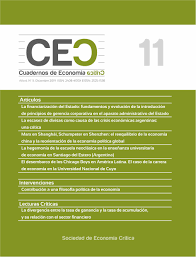
The neoclassical school hegemony in the economics university teaching in Santiago del Estero (Argentina)
Abstract
This article analyzes, first of all, the bibliographic and content selection in the economics programs in the universities of Santiago del Estero, showing that the adoption of conventional economics manuals and the repetition of the same authors (generally American) are consistent, and that most subjects are covered at a frequency of 88% or more. Thus, the norm in these curricula is the selection of similar contents within the neoclassical synthesis and the consequent absence of paradigmatic plurality, which reveals the hegemony of the neoclassical school in the teaching of economics in Santiago del Estero. Secondly, to understand how this situation originated, the historical-political process of burying alternative paradigms is developed. Finally, and in order to contribute with counter-hegemonic ideas, demands for transformation in the teaching of economics elaborated by prestigious intellectuals and international student movements are exhibited
Keywords: university curriculum; neoclassical school; hegemony.
Downloads
Published
Versions
- 2021-01-12 (2)
- 2019-12-01 (1)
How to Cite
Issue
Section
License
Copyright (c) 2019 Mariano Juan Parnas, Claudia Yésica Fonzo Bolañez

This work is licensed under a Creative Commons Attribution-NonCommercial-NoDerivatives 4.0 International License.
Copyright notice
Authors retain copyright and grant the journal the right to be the first publication of the work as licensed under a Creative Commons Attribution License that allows others to share the work with an acknowledgement of authorship of the work and initial publication in this journal.
Authors may separately enter into additional arrangements for non-exclusive distribution of the version of the work published in the journal (e.g., placing it in an institutional repository or publishing it in a book), with an acknowledgement of initial publication in this journal.
Authors are allowed and encouraged to disseminate their work electronically (e.g. in institutional repositories or on their own website) before and during the submission process, as it may lead to productive exchanges, as well as earlier and higher citation of published work (see The Effect of Open Access).


