
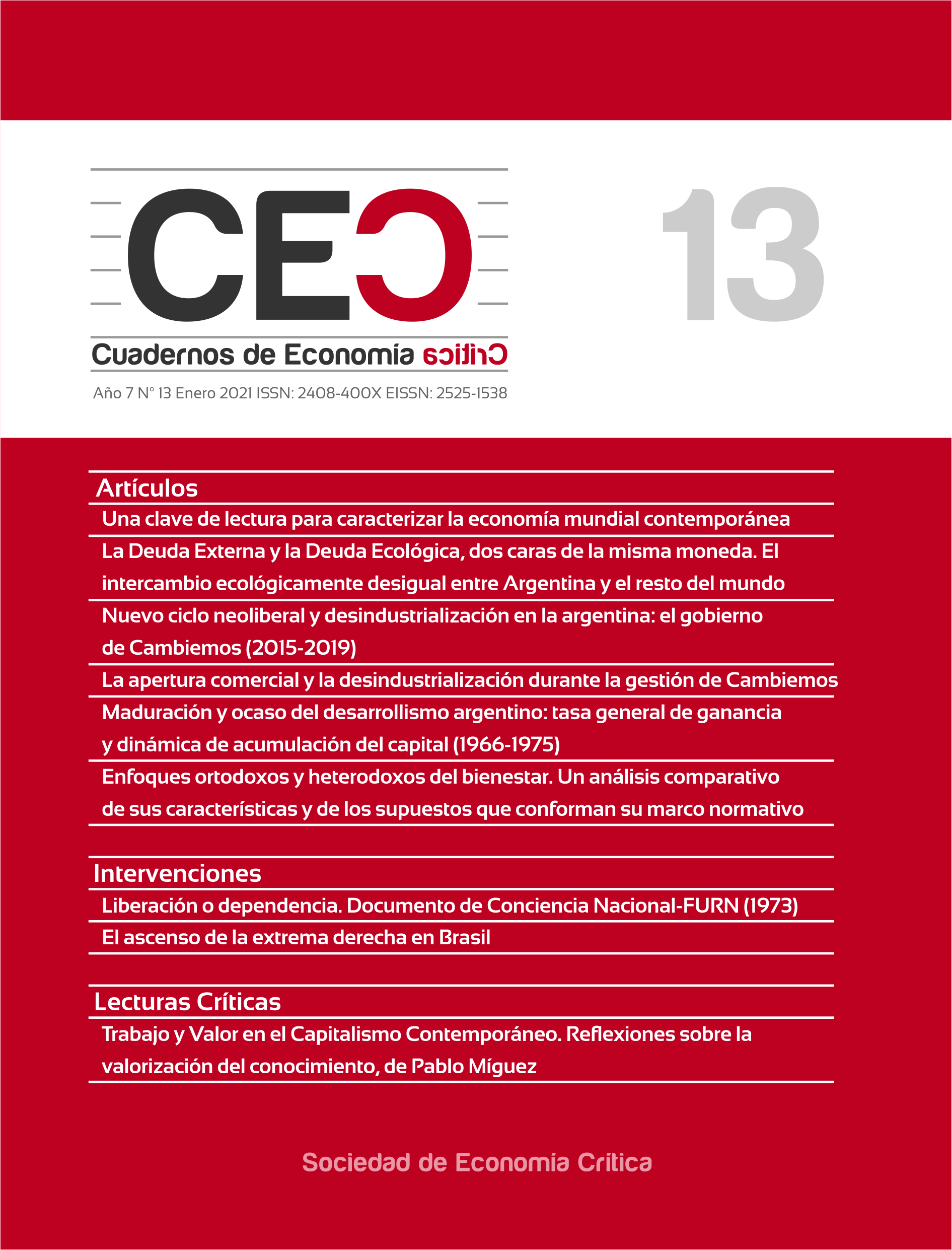
La External Debt and Ecological Debt, two sides of the same coin
The ecologically unequal exchange between Argentina and the rest of the world
Keywords:
political economy, ecological economics, sustainable development, international trade, development-underdevelopmentAbstract
The goal of this paper is to study the impact in environmental terms of the financial valuation (1976-2001) and the post-convertibility (2002-2015) accumulation patterns, through the concept of ecological debt. The central hypothesis is that the necessity of foreign currency to pay the external indebtedness generated in the financial valuation pattern has a direct relationship with the ecological debt since the foreign currency is obtained from a reprimarized export structure, which implies, on the one hand, unequal trade in terms of low-paid energy and material flows to the rest of the world; and, on the other hand, a reduction in net biocapacity, that is, the loss of the capacity that our territory has to supply useful natural resources and absorb the waste generated by the economic process. Based on this, the current work describes the ecologically unequal exchange in Argentina, within the framework of a growing external indebtedness while it reflects the increasing process of ecological loss in Argentina through the use of biophysical and monetary indicators.
Downloads
References
Auditoría General de la Nación. (2008). Informe de estudio especial de la deuda pública.
Azpiazu, D., Basualdo, E. y Khavisse, M. (2004). El nuevo poder económico en la Argentina de los años 80. Buenos Aires: Siglo XXI.
Azpiazu, D., Manzanelli, P. y Schorr, M. (2011). Concentración y extrajerización. La Argentina en la posconvertibilidad. Buenos Aires: Agencia de Promoción Científica y Tecnológica.
Basualdo, E. (2010). Estudios de historia económica argentina. Buenos Aires: Siglo XXI.
Basualdo, E. (2011). Sistema político y modelo de acumulación: tres ensayos sobre la Argentina actual. Buenos Aires: Atuel.
Basualdo, E. (2019). Fundamentos de Economía Política. Ciudad Autónoma de Buenos Aires: Siglo XXI.
Basualdo, F. (2013). Evolución y características de la minería metalífera en la Argentina reciente. La expansión de la actividad y el capital extranjero. En Basualdo, F. M. Barrera y Basualdo, E. Las producciones primarias en la Argentina reciente (pp. 9-96). Buenos Aires: Cara o Ceca.
Belloni, P. y Peinado, G. (2013). Inserción externa, capitales transnacionales e intercambio ecológicamente desigual en la América del Sur posneoliberal. Sociedad y Economía, (25), 15-38.
Bona, L. (2016). Del kirchnerismo al macrismo: ¿nueva hegemonía y bloque en el poder? Memoria Académica, IX Jornadas de Sociología, Universidad Nacional de La Plata
Colectivo de Difusión de la Deuda Ecológica (2003). Deuda Ecológica, ¿Quién le debe a quién? Barcelona: Icaria.
Federici, S. (2018). El patriarcado del salario. Críticas feministas al marxismo. . Madrid: Traficante de sueños.
Gaggero, A., Schorr, M., & Wainer, A. (2014). Restricción eterna. El poder económico durante el kirchnerismo. Buenos Aires: Futuro anterior.
Harvey, D. (2004). El "nuevo" imperialismo: acumulación por desposesión. Socialist Register, 40, 99-129.
Kulfas, M. (2019). Los tres kirchnerismos. Ciudad Autónoma de Buenos Aires: Siglo XXI.
Manzanelli, P., & Basualdo, E. (2016). Régimen de acumulación durante el ciclo de gobiernos kirchneristas. Realidad económica 304, 6-40.
Manzanelli, P., Barrera, M., Wainer, A., & Bona, L. (abril de 2015). Deuda externa, fuga de capitales y restricción externa. Desde la última dictadura hasta la actualidad. CEFID-AR(68). Recuperado de: HYPERLINK "http://www.iade.org.ar/system/files/dt68.pdf" http://www.iade.org.ar/system/files/dt68.pdf
Martínez Alier, J. (1997). Deuda ecológica y deuda externa. Ecología Política, 157-173.
Martínez Alier, J.y Roca Jusmet, J. (2000). Economía Ecológica y Política Ambiental. México D.F.: Fondo de Cultura Económica.
Muradian, R. y Martínez Alier, J. (2001). Trade and the environment: from a "Southern" perspective. Ecological Economics, (36), 281-297.
Peinado, G. (2015). Intercambio ecológicamente desigual e Intercambio desigual en Oscar Braun Nexos, puntos en común y especificidades. Revista Iberoamericana de Economía Ecológica, 24, 187-202.
Polanyi, K. (2017). La gran transformación. México D.F.: Fondo de Cultura Económica.
Schatan, J. (1998). El saqueo de América Latina. Deuda externa y neoliberalimo. Santiago: Fundación CENDA [Centro de Estudios Nacionales de Desarrollo Alternativo].
Svampa, M. (2019). Neoextractivismo y desarrollo. En Svampa, M. Las fronteras del neoextractivismo en América Latina (pp. 14-30). Guadalajara: CALAS.
Treacy, M. (2015). Dependencia, restricción externa y transferencia de excedente en la Argentina (1970-2013). Cuadernos de Economía Crítica, 1(2), 113-139.
Walter, M., Brun, J., Pérez-Manrique, P., González Martínez, A. C. y Martínez Alier, J. (2013). Análisis de flujo de materiales de la economía argentina (1970-2009). Tendencias y conflictos extractivos. Ecología Política, (45), 94-98.
World Wildlife Fund (2012). Living Planet Report 2012. Biodiversity, biocapacity and better choices. WWF International.
Published
How to Cite
Issue
Section
License
Copyright (c) 2020 Ain Mora, Paula Piccolo, Guillermo Peinado, Javier Ganem

This work is licensed under a Creative Commons Attribution-NonCommercial-NoDerivatives 4.0 International License.
Copyright notice
Authors retain copyright and grant the journal the right to be the first publication of the work as licensed under a Creative Commons Attribution License that allows others to share the work with an acknowledgement of authorship of the work and initial publication in this journal.
Authors may separately enter into additional arrangements for non-exclusive distribution of the version of the work published in the journal (e.g., placing it in an institutional repository or publishing it in a book), with an acknowledgement of initial publication in this journal.
Authors are allowed and encouraged to disseminate their work electronically (e.g. in institutional repositories or on their own website) before and during the submission process, as it may lead to productive exchanges, as well as earlier and higher citation of published work (see The Effect of Open Access).


